


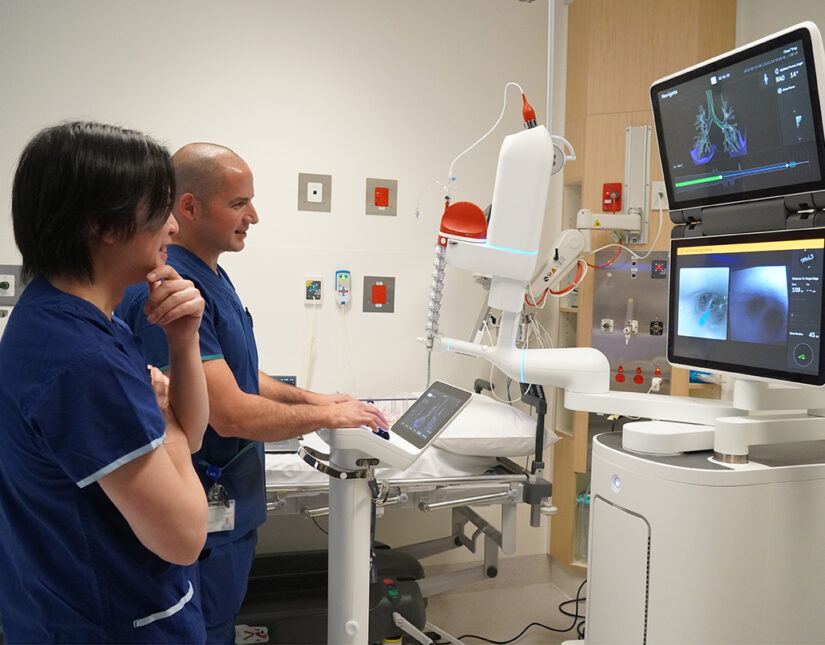
Over the past months, SA’s first robot-assisted bronchoscopy system has shown promising results during its trial at the Royal Adelaide Hospital (RAH).
In this article, Professor Phan Nguyen details how the technology navigates small, hard-to-reach lung nodules, while patient Jayne Saul – one of the first patients to undergo the procedure using the machine – tells her story.
For patients with suspected lung cancer, this technology could mean an earlier diagnosis and faster treatment planning.
Click here to read patient Jayne Saul’s story
Professor Phan Nguyen – Head of the Unit, Department of Thoracic Medicine, Royal Adelaide Hospital – is a proud South Australian and proud Vietnamese refugee who advocates for advancements in diagnostics and therapies for all patients referred to its services.
The thoracic procedure suite that Professor Phan Nguyen leads were among the first to perform advanced endobronchial ultrasound (EBUS) bronchoscopic procedures more than 18 years ago. Since then, the team has expanded its services to include lung volume reduction using endobronchial valves for patients with severe chronic obstructive airway disease. All the while being the primary referral centre for airways emergencies for the state as well as regions of Victoria, NSW and the NT.
A small group of dedicated physicians and amazing nursing and administrative staff have quietly gone about providing this care and support to patients and referrers alike.
More recently, the Thoracic Medicine Unit at RAH has gained media attention with the arrival of SA’s first robotic assisted bronchoscopy service – that which completed a successful biopsy on patient Jayne Sual. The robotic bronchoscopy has dramatically improved the diagnostic yield of small lung nodules, raising traditional diagnostics from bronchoscopic techniques from around 65-70% all the way up to 90%.
Robotic bronchoscopy has benefits to all patients with lung nodules – whether this is from benign causes or from cancer. We must emphasis that not only patients with suspected lung cancer can benefit, but all patients with any cancer with concerning spots on their lungs can benefit.
Professor Phan Nguyen and Associate Professor Arash Badiei are humbled and proud to be the only two physicians in South Australia who are trained with this technology and they both endeavour to bring its advancements and advantages to the patients who are referred to them.
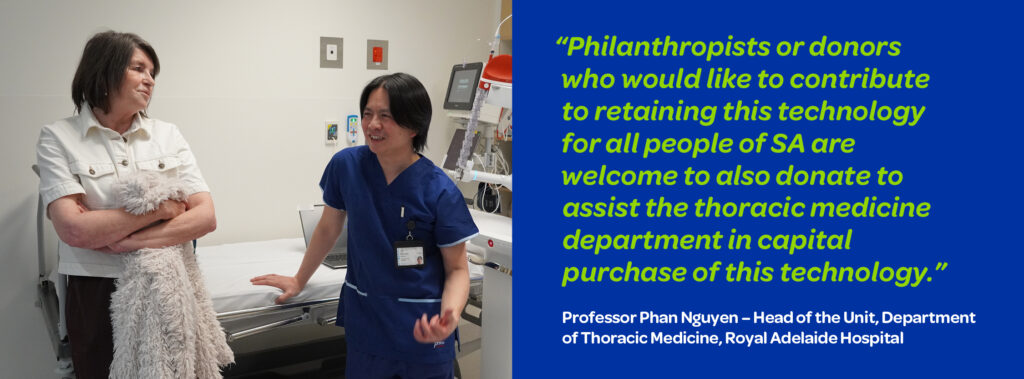
Since the robotic bronchoscopes’ release the Thoracic Medicine Unit have partnered with the South Australian immunoGENomics Cancer Institute (SAiGENCI) – led by Professor Brendan Jenkins – where they complete cutting edge research into future cancer therapies, impacting positively on care for generations to come.
How robot-assisted bronchoscopy works
Robot-assisted bronchoscopy combines advanced imaging, navigation and robotic technology to help clinicians safely reach small or hard-to-access lung nodules.
Trained respiratory physicians can guide a thin bronchoscope with greater precision and stability, allowing tissue samples to be taken for testing. This can support earlier, more accurate diagnosis for patients with suspected lung cancer or cancer that has spread to the lung.
For patients like Jayne, whose lesion was difficult to safely reach, the technology offers another way to access challenging areas, potentially reducing repeat procedures, complications, and waiting times.
Professor Phan Nguyen strongly believes this technology is an important step forward:
“Patients with lung cancers, or cancers of any kind that have spread to the lung, are now able to have more accurate and safer biopsies. This reduces diagnostic uncertainty and anxiety for patients, reduces complications and allows cancers to be treated at an earlier, curable stage.”
By donating, you can help fund robot-assisted bronchoscopy and clinician-led trials at RAH and CALHN, supporting safer, more coordinated care and earlier answers for patients during an uncertain time.